
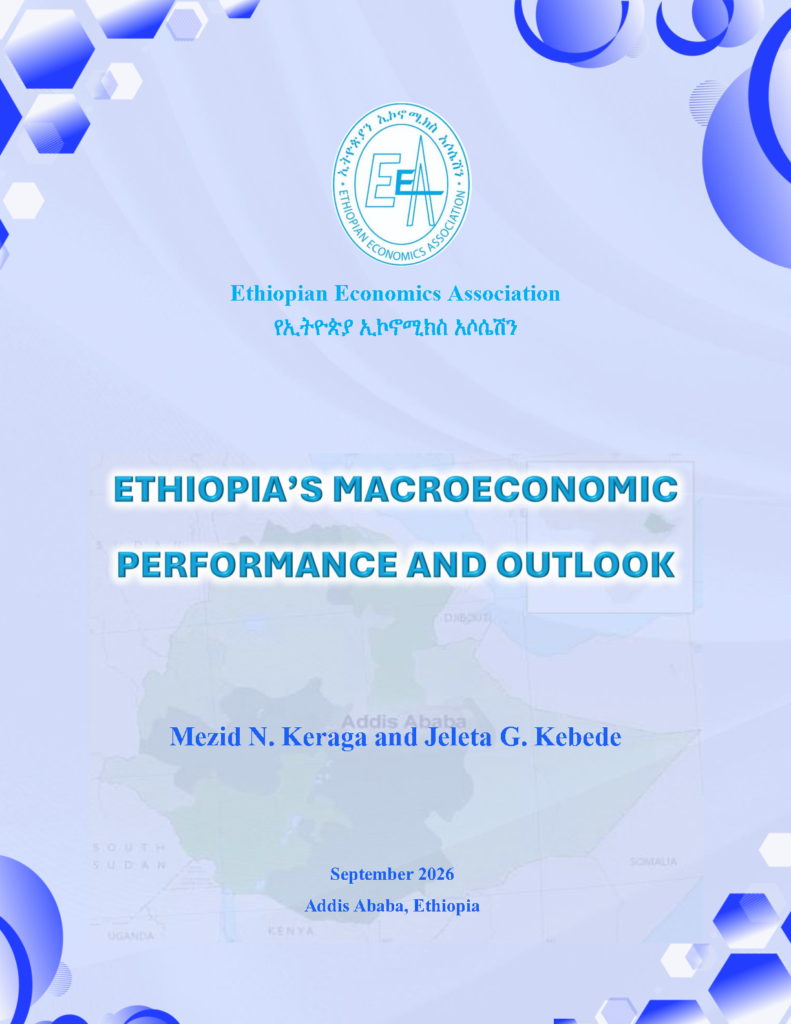
Addis Ababa – The Ethiopian Economics Association (EEA) has released Ethiopia’s Macroeconomic Performance and Outlook, the first edition of its Macroeconomic Outlook. It is the first publication of its kind among EEA’s various forms of publication. EEA will continue to publish the Outlook every year.
The report is written by Dr. Mezid N. Keraga and Dr. Jeleta G. Kebede of EEA’s research team. It reviews Ethiopia’s economic performance from 1993 to 2025 across the real, monetary, fiscal and external sectors. It also gives outlooks and policy recommendations.
Among the key findings:
- Strong growth has translated into only modest job creation. The employment elasticity of growth is 0.27, so a 1% rise in growth raises employment by 0.27%.
- A 1% increase in broad money supply is associated with a 1.55 percentage point rise in headline inflation.
- The tax-to-GDP ratio has stayed below 10% since 2018, and debt service pressures remain high.
- Exports remain concentrated in primary commodities, and the trade balance is in persistent deficit.
- Inflation is projected to ease only from 16.5% in 2026 to 14.9% by 2030. Reaching single digits would require controlled monetary expansion.
The report recommends a labour-intensive industrial policy, stronger revenue mobilization, a shift of spending toward capital investment, and slower money supply growth. It also recommends full foreign-exchange market unification.
As the 1st edition of the EEA Macroeconomic Outlook, this report marks a significant milestone in the Association’s commitment to delivering timely macroeconomic analysis and evidence-based policy insights.
Read the full report at: https://eea-et.org/wp-content/uploads/2026/11/Ethiopian-Economic-Outlook-Outline_revised-final.pdf